Why Epoxy Garage Floors Fail in Rockland County (And How Moisture Testing Prevents It)
Why Epoxy Garage Floors Fail in Rockland County (And How Moisture Testing Prevents It)
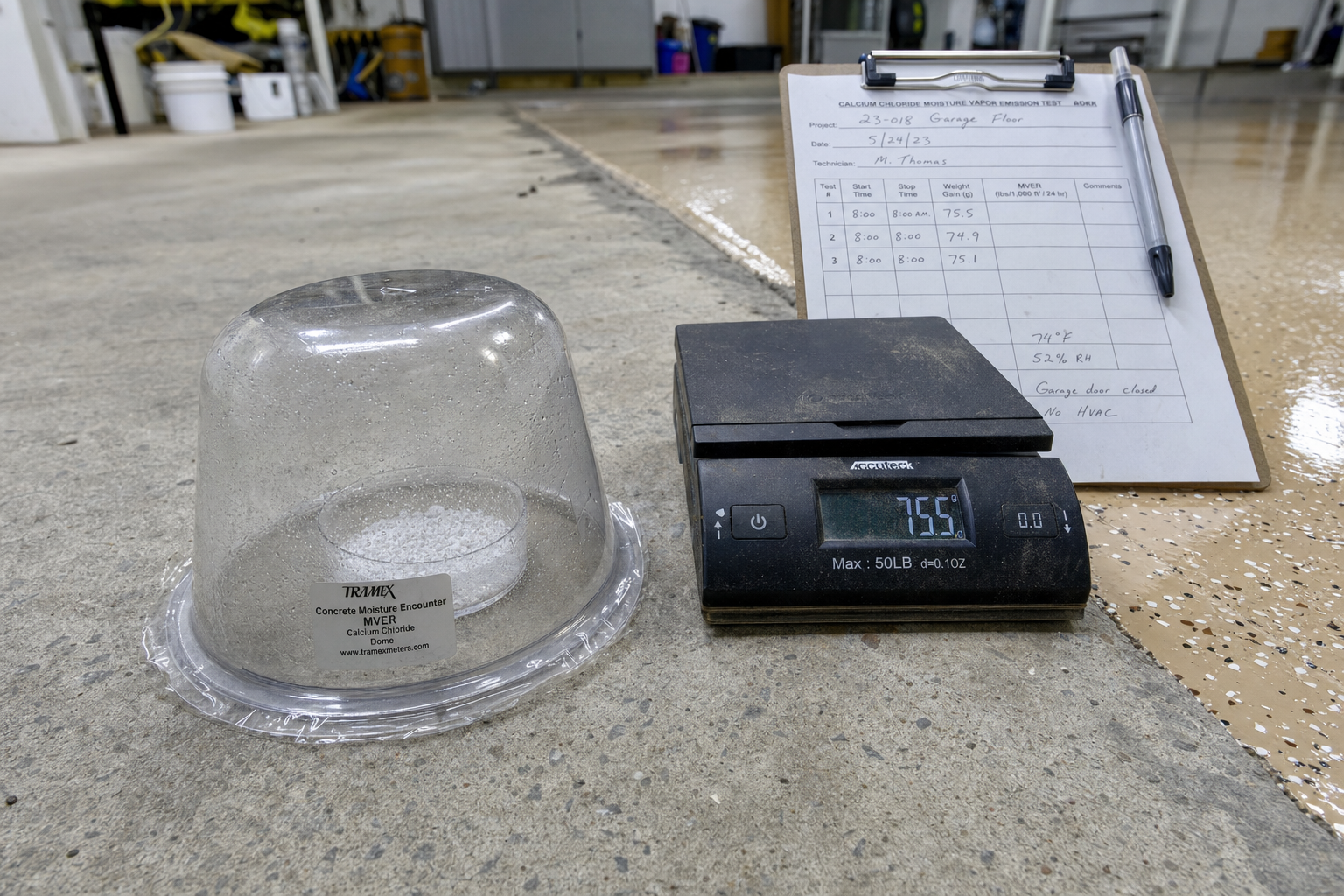
If you've seen an epoxy garage floor bubble, peel, or delaminate within a year or two of installation in Haverstraw, West Haverstraw, or anywhere in Rockland County, there's a good chance the real cause wasn't the coating — it was moisture the installer never tested for before they poured it on.
Concrete doesn't have to look wet to be a problem. A slab can appear perfectly dry to the touch while moisture vapor is still moving up through it from the soil below, and epoxy applied over that vapor drive will fail from underneath regardless of how well it was mixed or applied on the surface. In Rockland County specifically, decades of freeze-thaw cycling and repeated snowmelt saturation mean older garage slabs carry a genuinely higher risk of this than a comparable slab in a drier, warmer climate — which is exactly why we don't skip moisture testing on epoxy projects here.
Why Does an Older Rockland County Slab Carry More Moisture Risk?
We've written before about how Rockland County sees 40-60 freeze-thaw cycles in a typical winter, with water infiltrating concrete's porous structure, freezing, expanding by roughly 9%, and stressing the slab from the inside repeatedly over decades. That same moisture-infiltration history that causes visible surface cracking and spalling also means older slabs have absorbed and released water through their pore structure far more times than a slab in a climate without this kind of seasonal cycling. More cycles of moisture movement through the concrete generally correlates with a slab more likely to still be releasing vapor from below, even years after it was poured — exactly the condition that ruins an epoxy coating from underneath.
What Actually Happens When Epoxy Goes Down Over a Moist Slab?
Moisture vapor pushing up through concrete has nowhere to go once a non-breathable epoxy coating seals the surface. That trapped vapor pressure builds until it delaminates the coating from the slab, showing up as bubbling, blistering, or hollow-sounding sections you can detect by tapping the surface. In more severe cases, entire sections peel away in sheets. None of this is a workmanship failure in the epoxy application itself — it's a moisture problem that existed before the first coat ever went down, and no amount of careful rolling or mixing technique fixes it after the fact.
What Do the Two Standard Moisture Tests Actually Measure?
There are two distinct ASTM-standard tests used before epoxy installation, and they measure genuinely different things:
ASTM F1869 (Calcium Chloride Test) measures the moisture vapor emission rate (MVER) at the concrete surface. A pre-weighed dish of calcium chloride is sealed under a dome on the cleaned slab for 60 to 72 hours, then reweighed to calculate how much moisture vapor emitted from that section of concrete, expressed in pounds per 1,000 square feet per 24 hours.
ASTM F2170 (In-Situ Relative Humidity Probe) measures moisture conditions deeper inside the slab itself, using an electronic sensor placed into a drilled hole rather than reading only what's emitting at the surface. This method has become the more trusted standard for critical installations because it reflects what's happening throughout the slab, not just at the surface being tested.
These aren't interchangeable, and for a garage floor with real freeze-thaw exposure history, we generally recommend pairing both rather than relying on just one.
What Do the Numbers Actually Mean for Your Project?
Standard epoxy systems are typically limited to an MVER around 3 pounds per 1,000 square feet per 24 hours — above that threshold, a standard coating is a poor bet regardless of how well it's installed. Moisture-tolerant epoxy primers can handle significantly higher emission rates, often in the 15 to 25 pound range depending on the specific product, which is exactly the kind of system a slab with elevated moisture readings needs instead of a standard build. Getting this test result before the project starts, not after the coating fails, is what determines which system your specific slab actually needs.
Does Surface Prep Matter as Much as the Test Itself?
Yes, and this is where a concrete-first approach makes a real difference. Beyond moisture, the slab surface needs to be mechanically profiled — typically ground or shot-blasted to a CSP 2-3 profile — removing oil, grease, old sealers, and curing compounds before any coating goes down. Acid etching alone doesn't create an adequate profile for a coating expected to hold up under vehicle traffic and Rockland County winters. This is a fundamentally different scope than a simple degrease-and-roll approach, and it's exactly the kind of prep work a concrete contractor is positioned to do correctly, since we're already working with the substrate itself, not just the coating on top of it.
Does Road Salt Change Anything for a Garage Epoxy Floor Here?
It adds another layer of stress worth planning for. Vehicles tracking in road salt and de-icing chemicals throughout a Rockland County winter deposit that salt directly onto the garage floor, and repeated exposure can accelerate wear on a coating's surface over time, similar to the exterior concrete de-icing salt damage we cover in our guide on freeze-thaw damage in Rockland County. A garage floor coating here needs to hold up to more than foot traffic and oil stains — it needs to handle a genuine winter chemical load too.
What Does Proper Epoxy Garage Flooring Cost in Rockland County?
Cost depends on garage size, current slab condition, whether moisture mitigation is needed based on your test results, and the coating system selected. A slab that tests within standard limits costs less to prep than one requiring a moisture-tolerant system — which is exactly why testing happens before pricing is finalized, not after.
FAQ
Does my garage floor need to look wet to have a moisture problem?
No. Concrete can appear completely dry on the surface while moisture vapor is still moving through the slab from below, which is exactly why testing matters more than visual inspection.
What's the difference between the two standard moisture tests?
ASTM F1869 (calcium chloride) measures moisture vapor emission at the surface over 60-72 hours. ASTM F2170 uses an in-situ probe to measure relative humidity deeper within the slab itself. They measure different things and are often used together.
Why would an older Rockland County garage slab have more moisture risk than a newer one?
Decades of freeze-thaw cycling mean an older slab has absorbed and released water through its pore structure many more times than a slab in a climate without this seasonal cycling, which generally correlates with continued vapor emission.
Can a standard epoxy coating handle any moisture level?
No. Standard systems are typically limited to about 3 pounds of moisture vapor emission per 1,000 square feet per 24 hours. Above that, a moisture-tolerant primer or mitigation system is needed instead.
Does road salt affect epoxy garage floors in Rockland County?
Yes. Vehicles tracking in road salt and de-icing chemicals through winter can accelerate surface wear on a coating over time, which is worth factoring into product selection and maintenance expectations.
Get your garage slab properly tested before you commit to an epoxy system. Haverstraw Concrete handles the concrete prep, moisture testing, and coating as one project, not separate guesses.
Call (845) 347-5663 for a free assessment. Serving Haverstraw, West Haverstraw, Stony Point, Thiells, and all of Rockland County, NY.