Concrete Pool Deck Cost in Rockland County, NY: What Haverstraw Homeowners Pay in 2026
Concrete Pool Deck Cost in Rockland County, NY: What Haverstraw Homeowners Pay in 2026
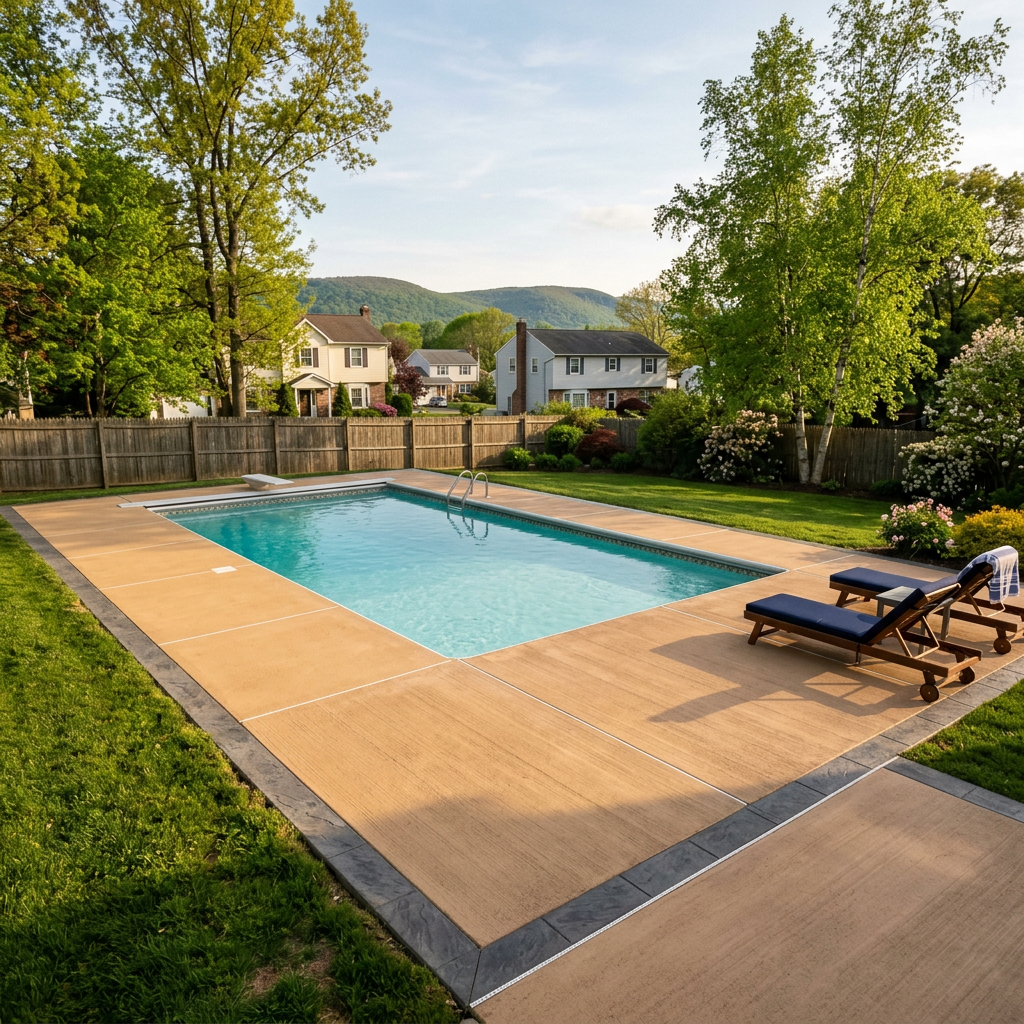
If you're opening your pool for the season and looking at a cracked, faded, or hopelessly stained deck — or if you just bought a Haverstraw home with an in-ground pool and no deck at all — concrete is almost certainly the answer you're going to land on. It's the most popular pool deck material in Rockland County for good reason: durable, customizable, lower-cost than stone or pavers, and able to handle 30+ freeze-thaw cycles a year if it's poured correctly.
What it costs is a different question, and most homeowners get blindsided by the gap between national pricing guides and what Hudson Valley contractors actually quote.
Here's what concrete pool decks really cost in Haverstraw, West Haverstraw, Stony Point, and surrounding Rockland County in 2026 — broken down by finish type, size, and the specific cold-climate requirements that drive Hudson Valley pricing higher than what you'll see online.
The Quick Answer
For a typical residential in-ground pool in Rockland County — roughly 16x32 feet with 600 to 800 square feet of surrounding deck — installed concrete pool deck pricing in 2026 runs:
- Standard broom-finished concrete: $9,000–$14,000 ($12–$18 per sq ft)
- Stamped concrete pool deck: $13,000–$22,000 ($16–$26 per sq ft)
- Decorative concrete with cool-deck coating: $14,000–$24,000 ($18–$30 per sq ft)
- Premium stamped with multiple colors and custom borders: $20,000–$32,000+ ($25–$40+ per sq ft)
Smaller decks around above-ground pools or plunge pools start around $4,500–$7,500 for basic broom finish. Large luxury installations around resort-style pools in Tomkins Cove or upper Stony Point can run $40,000–$60,000+ when integrating spas, fire features, multi-level decking, and premium decorative finishes.
These numbers include site prep, forming, reinforcement, pour, finishing, control joints, and initial sealing. They assume reasonable backyard access and no major demolition of an existing deck.
What Drives Pool Deck Cost in Rockland County
Pool deck pricing has more variables than most concrete projects because pool decks have to do things a patio doesn't.
1. Square Footage and Deck Width
The standard pool deck width around an in-ground pool runs 4 to 6 feet on the main sides, with wider zones (8–12 feet) on the entry side or where lounge furniture goes. Larger overall square footage drops the per-foot price slightly — there's economy of scale on labor and material delivery — but increases total project cost meaningfully.
A 600 sq ft basic deck at $14/sq ft is $8,400. The same deck at 1,000 sq ft is $14,000. Plan deck size around how you actually use the pool, not what looks generous on paper.
2. Finish Type
This is the single largest pricing variable.
Broom finish is the most economical and the most popular for Rockland County pool decks. The wet concrete is dragged with a stiff-bristled broom to create a textured, slip-resistant surface. Costs land at $12–$18/sq ft installed. Reliable, durable, and the surface texture provides natural slip resistance — important for a wet pool surround.
Exposed aggregate removes the surface cement layer to reveal the decorative stones in the mix. Excellent slip resistance, distinct visual texture, and well-suited to traditional Rockland County architecture. Runs $14–$22/sq ft installed.
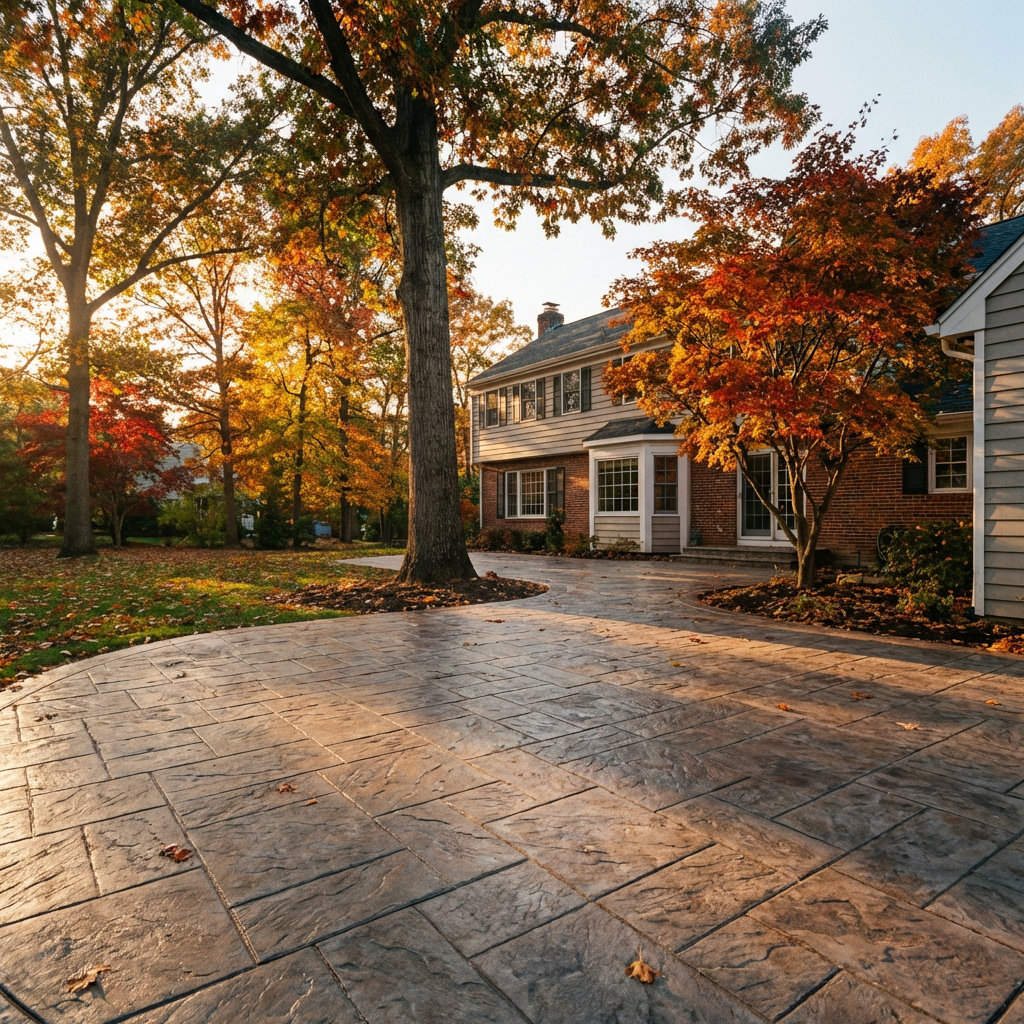
Stamped concrete uses textured stamps and coloring to mimic flagstone, slate, brick, or wood. Visually striking, more design flexibility, but requires careful slip-resistance treatment for pool environments — stamped concrete can be slippery when wet without the right finish. Runs $16–$26/sq ft installed.
Stamped with cool-deck topping combines stamped concrete with a textured acrylic or polymer-cement topping that reduces surface temperature in summer and adds slip resistance. The right call for high-sun exposed decks. Runs $18–$30/sq ft installed.
Decorative scored or stained concrete uses saw-cut patterns and chemical stains to create custom designs without stamping. Mid-range pricing, contemporary look. Runs $14–$22/sq ft installed.
3. Demolition of Existing Deck
If you're replacing an existing concrete or paver pool deck, demolition runs $2–$5 per square foot in Rockland County depending on thickness and access. A 700 sq ft demo can add $1,400 to $3,500 before any new work begins. Old paver decks are sometimes faster to remove than poured concrete, but disposal volume is higher.
4. Site Conditions and Drainage
Pool decks have stricter drainage requirements than patios because standing water is a slip hazard and accelerates surface scaling in freeze-thaw conditions. Proper installation includes:
- A 1–2% slope away from the pool toward designated drainage zones
- Often a perimeter drain or trench drain for areas where slope alone isn't enough
- Subsurface drainage if your backyard sits in a low area or has clay soil retaining water
Hudson Valley clay soil, common throughout Haverstraw and Stony Point, doesn't drain well. Many pool deck installations in Rockland County require additional excavation, gravel base depth, and sometimes French drain integration. This can add $1,500 to $5,000 to the project depending on site conditions.
5. Pool Coping Integration
The coping — the top edge of the pool wall — is where the pool meets the deck. New pool deck installation often coincides with coping work. If your existing coping is in good shape, the new deck simply abuts it. If coping is damaged or you're upgrading from a basic concrete coping to natural stone or precast, expect $40–$80 per linear foot for new coping. A 16x32 pool has roughly 96 linear feet of coping — $3,800 to $7,700 if it needs replacement.
6. Cold-Climate Requirements (Non-Negotiable in Rockland County)
This is where Rockland County pricing legitimately runs higher than Sun Belt averages, and why the cheap quotes you see online often won't survive a Hudson Valley winter.
Concrete thickness. Pool decks should be poured at minimum 4 inches thick, with 5 inches preferable around the pool entry and any heavy-traffic zone. Cheap quotes sometimes spec 3 to 3.5 inches — the slab won't survive 30+ freeze-thaw cycles without scaling and cracking.
Air-entrained concrete mix. Microscopic air bubbles intentionally introduced into the mix give expanding ice somewhere to go, dramatically reducing freeze-thaw scaling. This is non-negotiable for outdoor concrete in Rockland County and adds $5–$10 per cubic yard to the mix cost. Confirm it's specified before signing.
Compacted gravel base. A 4–6 inch compacted #2 stone or crushed gravel base is required to prevent cracking from frost heave. Some contractors skip this on pool decks because the existing pool excavation already disturbed the soil. Don't accept that — pool deck areas need fresh, properly compacted base.
Reinforcement. Wire mesh or rebar on chairs is standard. Skipping reinforcement is a budget-pricing tell. Pool decks see thermal cycling, pool chemistry exposure, and constant wet/dry cycling that demand reinforcement.
Control joints. Properly placed control joints — typically every 8 to 10 feet — guide cracking to predictable lines instead of letting random cracks ruin the decorative surface.
PSI rating. Minimum 3,500 PSI mix for residential pool decks; 4,000 PSI is better. Some bargain mixes are 3,000 PSI, which is below spec for cold-climate exterior work.
A contractor who doesn't proactively discuss any of these specifications is not the right fit for a Rockland County pool deck project.
7. Permits
Rockland County and individual Haverstraw, West Haverstraw, and Stony Point municipalities require building permits for pool deck construction, particularly when affecting drainage, exceeding certain square footage, or installed within setback zones. Permit fees typically run $200–$500. A legitimate contractor includes permit handling and pulls the permit before work begins. Skipping permits creates problems at home sale time when an inspector flags unpermitted work.
Pricing by Pool Type and Deck Configuration
Above-ground pool with basic surrounding deck (200–400 sq ft): $3,500–$7,500. Broom finish standard, simpler forming, less drainage complexity.
In-ground pool with standard 4–6 ft perimeter deck (16x32 pool, ~600–800 sq ft): $9,000–$22,000 depending on finish.
In-ground pool with extended deck and lounge zones (1,000–1,500 sq ft): $14,000–$35,000. Larger gathering space, often with built-in features.
Resort-style pool deck (2,000+ sq ft, multi-zone): $30,000–$60,000+. Premium finishes, integrated spa surrounds, fire features, custom borders, multi-level decking.
Pool deck replacement only (demo + new pour, ~700 sq ft): $11,000–$25,000 depending on finish, including demolition.
Concrete Pool Deck vs. Pavers vs. Natural Stone in Rockland County
The honest comparison most Haverstraw homeowners want.
Cost
- Poured concrete: $12–$26/sq ft installed
- Concrete pavers: $18–$30/sq ft installed
- Travertine pavers: $22–$35/sq ft installed
- Natural flagstone: $25–$45/sq ft installed
- Bluestone: $28–$50/sq ft installed (very popular in the Hudson Valley aesthetically, but premium pricing)
For equivalent square footage, poured concrete is generally the lowest-cost option, with stamped concrete coming in at the lower end of paver pricing while delivering similar visual appeal.
Freeze-Thaw Performance
Properly poured concrete with air entrainment, adequate thickness, and correct subbase performs well in Rockland County winters. Pavers are more forgiving of ground movement because individual units can heave and be reset — but joint sand washes out, weeds establish in joints, and deicer use can accelerate paver wear at the joint lines.
The real comparison is not "concrete cracks and pavers don't" — both materials require correct installation. It's "concrete fails at the slab level if installed wrong; pavers fail at the joint level if maintained wrong."
Slip Resistance
Pavers and natural stone generally have better wet-surface slip resistance than smooth concrete. This is fixable on concrete with the right finish — broom finish, exposed aggregate, or cool-deck topping — but smooth troweled concrete is genuinely slippery when wet and inappropriate for a pool surround. If you're pricing concrete, you're pricing textured concrete.
Heat Retention
Dark concrete and dark pavers both get hot under direct summer sun. Light-colored concrete with cool-deck topping is the coolest surface for bare feet. Travertine is naturally cooler than most concrete. Standard mid-tone concrete is comparable to most paver products in heat retention.
Repairability
Pavers have a real advantage here — individual units can be replaced. Concrete repair is harder to make invisible because color-matching cured concrete is difficult. That said, for most pool deck damage, the practical reality is that you're either patching cracks (which works on either material) or replacing a section (which is harder on concrete but rarely needed if installed correctly).
When to Replace a Pool Deck
Some signs your existing concrete pool deck is past repair and into replacement:
- Wide cracks (over 1/4 inch) running across multiple control joint lines
- Vertical displacement between sections — one panel sitting higher than another, indicating settling or heaving
- Extensive scaling or spalling affecting more than 20–25% of the surface
- Drainage failure — water pooling on the deck or running toward the pool instead of away
- Coping separation from the deck, allowing water infiltration behind the pool wall
- Age — concrete pool decks installed before 1990 often used mix designs and reinforcement standards that don't hold up to 30+ years of Hudson Valley winters
Surface staining, faded color, minor hairline cracks, and worn sealer are all maintenance issues, not replacement triggers.
Maintenance Costs to Budget
A new pool deck isn't a one-time expense — it's a long-term investment that requires ongoing care.
Resealing every 2–3 years: $1.50–$3 per square foot, or roughly $900–$2,400 for a 600 sq ft deck. Sealer protects against pool chemistry, UV fading, and freeze-thaw moisture intrusion.
Pressure washing before resealing: $200–$400 typically bundled with the reseal service.
Crack maintenance: Hairline cracks are normal; larger cracks (1/8 inch or wider) should be filled within the first year to prevent water infiltration. Annual inspection costs nothing if you do it yourself; professional crack repair runs $200–$600 per visit depending on extent.
Avoiding rock salt: Use sand for traction in winter. Rock salt and calcium chloride aggressively damage sealed concrete pool decks. This is a habit cost more than a dollar cost.
A well-installed concrete pool deck in Rockland County, properly maintained, lasts 25–30 years before significant rehabilitation is needed.
Timing Your Pool Deck Project in Rockland County
Concrete pool deck installation is highly seasonal in Hudson Valley.
Optimal pour window: April through October. Concrete should not be poured when temperatures are below 40°F or when temperatures are forecast to drop below freezing within 48 hours of pour. Mid-April through mid-October is the realistic window.
Best timing: May through September. Stable temperatures, lower freeze risk, ideal curing conditions. Schedule early in the season for May/June pour dates — quality contractors book up fast once pool season opens.
Late season pours (October): Possible with curing blankets and careful weather monitoring. Sometimes the only option for fall projects, but adds risk.
Pool deck replacement timing: Plan for the pool to be unusable for 28+ days after pour. New deck cannot be filled with pool water (chemistry exposure) or used for furniture for the full cure period. Schedule replacement for spring or early summer to maximize usable pool season after curing.
Frequently Asked Questions
How long does concrete pool deck installation take in Haverstraw? For a standard 700 sq ft pool deck: 1–2 days for site prep and demolition, 1 day for forming and pour, 1 day for stamping or finishing if decorative. Initial sealing happens at 28–30 days after pour. Total project from start to sealed finish: 5–6 weeks accounting for permit processing and curing time.
Can I use my pool while the new deck is curing? Light foot traffic on the deck is fine after 5–7 days. Pool can typically be filled and used after 14 days, but pool chemicals should not contact uncured concrete — keep the deck dry and avoid splash-out for the first 14 days minimum.
Will pool chemicals damage my concrete deck? Properly sealed concrete withstands normal pool chemistry. Splash exposure to chlorinated and salt-system pools is fine on sealed surfaces. The damage comes from concentrated chemical contact (a leaking chlorinator, spilled acid for pH adjustment) on unsealed concrete. Reseal every 2–3 years and don't store chemicals on the deck.
Is stamped concrete too slippery for a pool deck? Standard stamped concrete can be slippery when wet. The fix is either selecting a deeply textured stamp pattern (slate or stone textures rather than smooth wood patterns), applying an anti-slip additive to the sealer, or using a cool-deck topping over the stamped surface. A reputable contractor will discuss slip resistance proactively for pool deck applications.
Do I need a permit for pool deck work in Haverstraw? Most pool deck installations in Haverstraw, West Haverstraw, and Stony Point require a building permit, particularly for new construction or replacement that affects drainage. Permit handling should be included in your contractor's scope.
Can a concrete pool deck be installed around an above-ground pool? Yes. Above-ground pool decks are typically smaller (200–400 sq ft) and follow the pool's circular or oval shape. Forming the curves adds labor time but the overall project is simpler than in-ground installations.
What about saltwater pools — is concrete still appropriate? Yes, with the right sealer. Salt-system pools deposit small amounts of salt onto deck surfaces during splash-out and evaporation. A high-quality sealer designed for pool deck applications handles salt exposure with the same 2–3 year reseal interval as standard pools.
Can I add a pool deck to my existing pool? Most existing in-ground pools were originally installed with at minimum a small concrete coping band but sometimes without a full deck. Adding a deck is straightforward as long as the pool structure and coping are sound. The deck is poured up to (but not bonded to) the existing coping, with appropriate expansion joint detailing.
What's the lifespan of a concrete pool deck in Rockland County? With proper installation (air-entrained mix, adequate thickness, correct base, proper drainage) and consistent maintenance (resealing every 2–3 years, no rock salt, prompt crack repair), 25–30 years is realistic. Decks that fail earlier typically fail because of installation shortcuts rather than the material itself.
Is the deck cost included in pool installation quotes from pool builders? Sometimes a basic concrete band is included; full perimeter decks are usually a separate line item or excluded entirely. Pool builders often subcontract the deck work to a concrete specialist. You can either accept their subcontractor or hire your own concrete contractor directly — direct hire often saves 10–20% on the deck portion.
Get a Free Pool Deck Estimate in Rockland County
Haverstraw Concrete installs and replaces concrete pool decks throughout Haverstraw, West Haverstraw, Stony Point, Thiells, Garnerville, and surrounding Rockland County communities. Every project includes proper subbase preparation, air-entrained 4,000 PSI mix designed for Hudson Valley winters, wire mesh or rebar reinforcement, correctly placed control joints, drainage detailing, permit handling, and initial sealing at the correct cure interval.
Call (845) 347-5663 for a free on-site estimate. We'll measure your existing deck or proposed deck area, walk through finish options on a physical sample board, and give you a written quote with everything spelled out — concrete thickness, mix PSI, reinforcement type, base depth, and cure schedule. No vague line items.
Spring and early-summer pour slots fill fast. If you want a new deck for summer 2026, getting on the schedule in May or early June is the realistic window.
Licensed and insured. Serving Rockland County, NY.